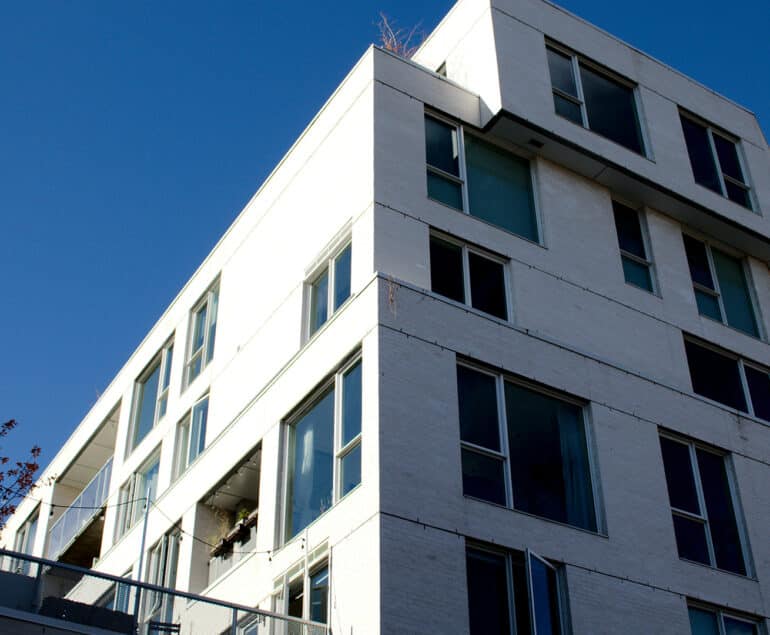
With the arrival of the COVID-19 pandemic and the rise in popularity of telecommuting in most professional settings, many city dwellers saw it as an opportunity to migrate to the remote suburbs of Montreal. For several months now, we have been witnessing a movement that could be described as an urban exodus. As a result, the city’s large buildings are seeing their condo units increasingly subject to housing leases, as owners take advantage of the circumstances to make the most of their residences that they no longer occupy.
What are the consequences on the rights of co-owners, who may then see their peace of mind disturbed by this influx of rentals?
The declaration of co-ownership between the co-owners of a building is undoubtedly contractual in nature. Indeed, it has all the constituent attributes of a contract: It represents an agreement of wills, by which one or more persons bind themselves to one or more others to perform a service (1378 Civil Code of Québec). As Christine Gagnon states in her book La copropriété divise, “in the declaration of co-ownership, all the owners unanimously agree to establish the modality, to determine the interest of each co-owner through the relative value of the fractions, to set the boundaries of the private portions, to qualify certain common elements and others as private, etc. ». 1
The declaration of co-ownership therefore contractually binds the co-owners who are committed to respecting its provisions towards each other. What happens to these obligations when a unit of the condominium building is rented out under a residential lease? What happens when rentals become detrimental to resident co-owners who then see their living environment, which was once stable, quiet and safe, now greatly affected and changed?
Obviously, we cannot comment on this issue without addressing the fact that our Quebec civil law is governed by the essential principles of freedom of contract and the fact that an owner has the right to use, enjoy and dispose of his property freely and completely, subject to certain limits. It is on these limits that we will dwell.
Article 1056 of the Civil Code of Québec imposes a significant limit on the contractual freedom of co-owners by stating that “the declaration of co-ownership may not impose any restriction on the rights of co-owners, except those justified by the purpose of the immovable, its characteristics or its situation.” Then, article 1063 C.C.Q. reinforces this point by adding that “each co-owner has his fraction; he freely uses and enjoys his private portion and the common portions, provided that he respects the rules of the building and does not infringe either the rights of the other co-owners or the purpose of the building.”
This is where it becomes interesting to focus on the notion of “destination of the building”. In the preparatory work for the French law that served as an inspiration for our own legislation, this definition was proposed: “The set of conditions under which a co-owner has purchased his lot, taking into account the various elements, in particular all the clauses, the contractual documents, the physical characteristics and the location of the building, as well as the social situation of the occupants”2. This definition has been adopted by several Quebec courts in this area.
By studying the case law on this issue, we realize that the courts have very cautiously approached the limit to which the Syndicate of co-owners of an immovable must comply when the time comes to infringe on certain rights and freedoms of its co-owners.
The Court of Appeal dealt with this in the leading decision of Kilzi v. The Syndicate of Co-owners of 10 400 boul. Acadia3 in which the co-owners, in order to counter the short-term rental of the condo units in their building, described the characteristics and environment of the building as follows: “the quality of the whole, the calm, the tranquility, the absence of noisy activities, the security of the building, the surroundings, the size of the units, their new condition…” ». Taking into account these specific attractions of the building, the court concluded that the purpose of the building made it possible to impose restrictions on short-term rentals, holding that these restrictions confirmed the residential character of the condominium and were intended to ensure a reasonable exercise of the right to rent.
In Rathé v. Syndicat de la copropriété 7 Sainte-Angèle4, the Syndicate of co-ownership authorized by regulation the rental of apartments for periods of less than one year, but more than 30 days. One of the co-owners complained to the court, claiming that it contravened the declaration of co-ownership by considerably affecting the tranquility and security of the building. The decision is relevant in that it distinguishes between what is commercial and what is not in the rental of apartments and concludes that the rental of apartments for a period of more than 30 days is undoubtedly a non-commercial activity and a residential use respecting the purpose of this building. It will therefore remain an authorized residential activity.
That being said, it is important to observe the consequences that a change in the building’s by-law can have on the rights and obligations of tenants. Are they bound by this amendment? Article 1057 C.C.Q. provides that “the by-law of the immovable is enforceable against the tenant or occupant of a private portion, as soon as a copy of the by-law or the amendments made thereto is given to him by the co-owner or, failing that, by the syndicate.” The problem with this amendment, whatever it may be, is the rules relating to the lease of a dwelling, which are, moreover, of public order and which tell us, more particularly in article 1942 C.C.Q., that the conditions of the lease cannot be modified, except at the time of renewal, and upon prior notice 3 months before the end of the term. A tenant would therefore be obliged to comply with such a modification only at the end of his lease.
On this issue of the enforceability of the building’s by-laws against a tenant, we must address the decision in Syndicat de copropriété du lot 4185331 v. Staikos5, in which the Syndicate claimed damages from one of its co-owner members attributable to the continuous barking of its tenant’s dog, relying on the nuisance provisions set out in the building’s by-laws. The court then established that since the tenant was not a signatory to the declaration of co-ownership or subject to it, there was no legal relationship between her and the Syndicate and therefore denied any claim to the tenant. It was the landlord who was ordered to pay damages to the syndicate for the fault of his tenant.
[1] Christine GAGNON, La copropriété divise,3rd ed., Cowansville, Éditions Yvons Blais, 2015, p. 722.
[2]François GIVORD and Claude GIVERDON, La copropriété, 4thed. , Daloz, Paris, 1002, p. 296.
[3] Kilzi v. Syndicate of co-owners of 10 400 boul. Acadia , 2001 CanLII 10061 (QCCA).
[4] Rathé v. Syndicat de la copropriété 7 Sainte-Angèle, 2019 QCCS 5624.
[5] Syndicat de copropriété du lot 4185331 v. Staikos, 2018 QCCQ 6513.